Voltage drop: why a cable that carries the current can still be too long
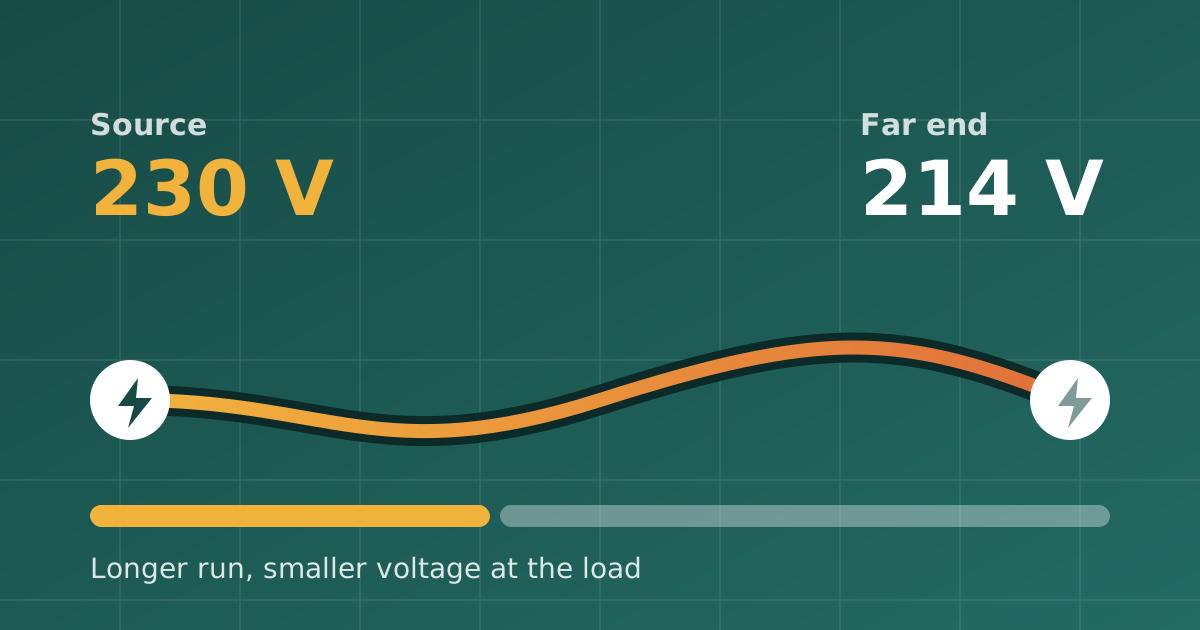
Choosing a cable by its current rating is only half the job. Over a long run, voltage drop usually decides the size.
Read article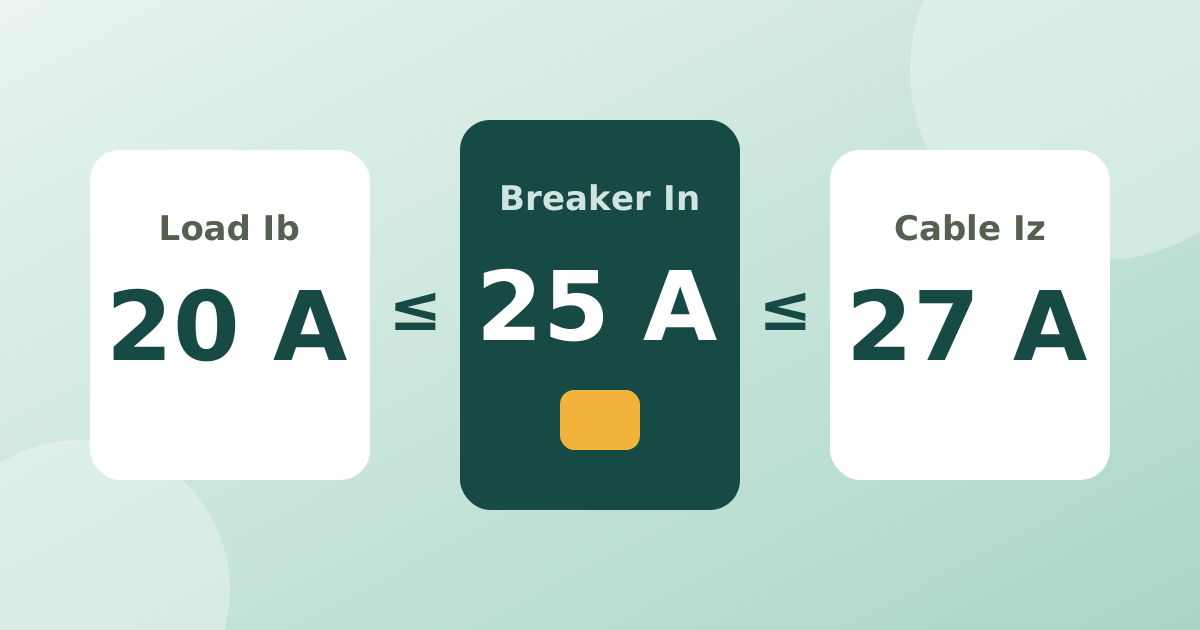
To choose a breaker for a cable, follow Ib ≤ In ≤ Iz: the breaker rating In must be at least the load current Ib and no higher than the cable's current-carrying capacity Iz. The breaker protects the cable, so a breaker bigger than the cable can carry lets the cable overheat before anything trips. This is the core overload rule in IEC 60364, and it is easy to apply once you have the corrected cable rating.
If a load draws 18 A, any breaker from 20 A up can carry it, but only if Iz is at least that breaker rating too. The best choice is the smallest standard breaker above Ib that the cable also covers.
Using tabulated currents for two loaded conductors, PVC insulation, installation method C (clipped direct) before any derating:
| Cable | Tabulated Iz | Common maximum breaker | Typical use |
|---|---|---|---|
| 1.5 mm² | 19.5 A | 10 A | Lighting circuits |
| 2.5 mm² | 27 A | 20 A | Socket circuits |
| 4 mm² | 36 A | 32 A | Cookers, showers, EV chargers |
| 6 mm² | 46 A | 40 A | Larger showers, sub-mains |
| 10 mm² | 63 A | 50 A | Sub-mains, heat pumps |
The "common maximum" is lower than Iz on purpose: it leaves a margin for derating, and breakers come in fixed steps. Your national wiring rules may set different limits, so check them for the final design.
An 8.5 kW shower on 230 V draws about 37 A, so Ib = 37 A.
The check is simple, but the derating step is where many installs go wrong. The related guides on voltage drop on long cable runs show the next check you need.
A breaker rated above Iz can let a sustained overload run through the cable. The cable heats beyond its insulation limit, 70 °C for PVC, with no trip. The fix is never "a bigger breaker": it is a bigger cable, or a lower-rated breaker, or a smaller load.
Cable Calc runs all of these checks on one screen: cable size to IEC 60364, temperature and grouping derating, breaker rating and voltage drop. It works offline, so you can use it on site. If you prefer the browser, the free cable size calculator does the same sums. More guides are in our electrical and cables section.
For two-conductor PVC copper cable clipped direct (installation method C), 2.5 mm² carries about 27 A, so a 20 A breaker is the usual choice for socket circuits. After derating for heat and grouping the usable current can be lower, so check it.
No. The breaker must trip before the cable overheats, so its rating In must not exceed the cable's corrected current-carrying capacity Iz.
Ib is the design current of the load, In is the rated current of the protective device, and Iz is the current-carrying capacity of the cable after correction factors. The rule is Ib ≤ In ≤ Iz.
Not directly, but a long run can force a larger cable to keep voltage drop within limits. The breaker still must not exceed the cable's Iz, and short-circuit trip times matter on long runs.
Choosing a cable by its current rating is only half the job. Over a long run, voltage drop usually decides the size.
Read articleAn expired passport is not found out at home, it is found out at the airport. Here is when to renew each document and how to get a reminder long before it matters.
Read articleTwenty-five minutes on, five off, a longer break every fourth round. The classic Pomodoro setup works for many people, and it is easy to tune when it does not.
Read articlePublished: . More in Electrical & cables or all articles.