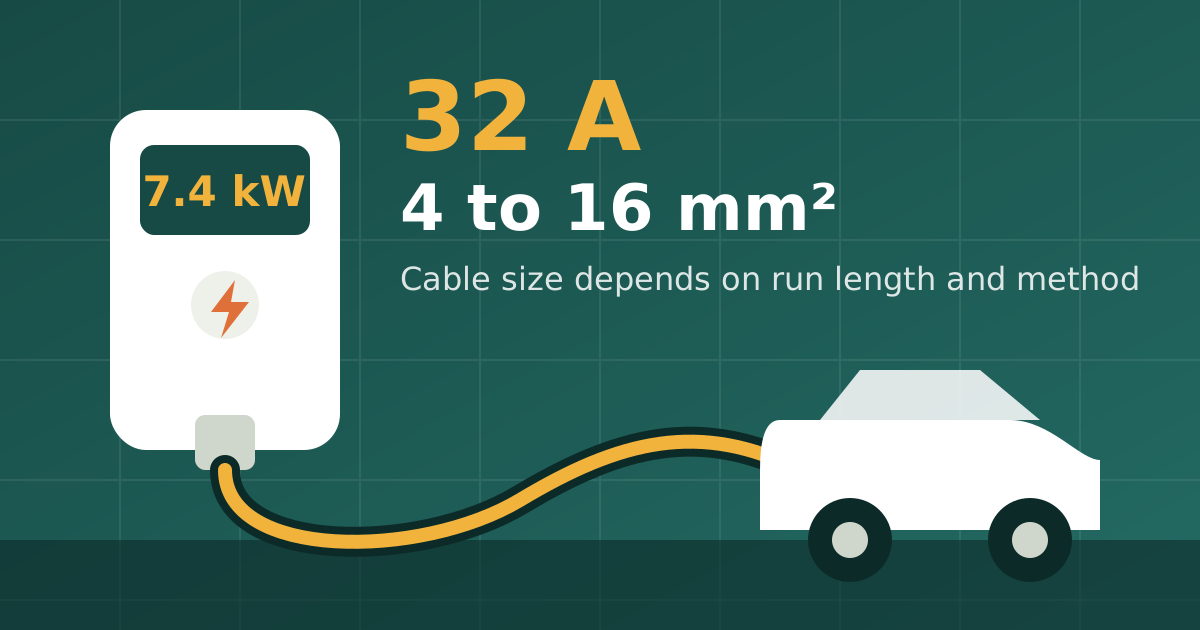
A 7.4 kW home EV charger is a 32 A single-phase load, and on a short run clipped to a wall it needs a 4 mm² copper cable. Put the cable in an insulated wall and it goes up to 6 mm²; stretch the run to 30 m and it is 10 mm² either way. The rating of the cable, the breaker and the voltage drop all have to pass, and the biggest result sets the size.
Why you size for the rated current, not the power
A charger draws its full rated current for hours at a time. IEC 60364-7-722 therefore treats it as a continuous load: size the circuit for the charger's rated current, with no diversity allowed. A 7.4 kW charger on 230 V is 32 A (7,400 ÷ 230 ≈ 32). If the charger lets you set a lower limit such as 16 A, size for the setting you will really use, and remember someone may raise it later.
EV charger cable size by length and installation method
Copper PVC cable at 30 °C, not grouped with other circuits, sized for a 3% voltage drop on the charger circuit. The breaker equals the charger's rated current.
Charger
Installation
15 m
30 m
50 m
7.4 kW (32 A, 1-phase 230 V)
C, clipped direct
4 mm²
10 mm²
16 mm²
7.4 kW (32 A, 1-phase 230 V)
A1, insulated wall
6 mm²
10 mm²
16 mm²
11 kW (16 A, 3-phase 400 V)
C, clipped direct
1.5 mm²
2.5 mm²
4 mm²
11 kW (16 A, 3-phase 400 V)
A1, insulated wall
2.5 mm²
2.5 mm²
4 mm²
22 kW (32 A, 3-phase 400 V)
C, clipped direct
4 mm²
4 mm²
6 mm²
22 kW (32 A, 3-phase 400 V)
A1, insulated wall
10 mm²
10 mm²
10 mm²
Three-phase chargers need far thinner cable for the same power because each conductor carries less current and the voltage-drop factor is lower. The numbers come from IEC 60364-5-52 Annex B capacities with temperature and grouping factors applied; a hot garage or several circuits in one conduit can push you up a size.
The three checks behind the table
Current-carrying capacity. After derating, the cable must carry at least the breaker rating. Insulated walls (A1) shed heat badly, which is why the same 32 A needs 6 mm² there but only 4 mm² when clipped to a wall. See how to choose a breaker size for a cable.
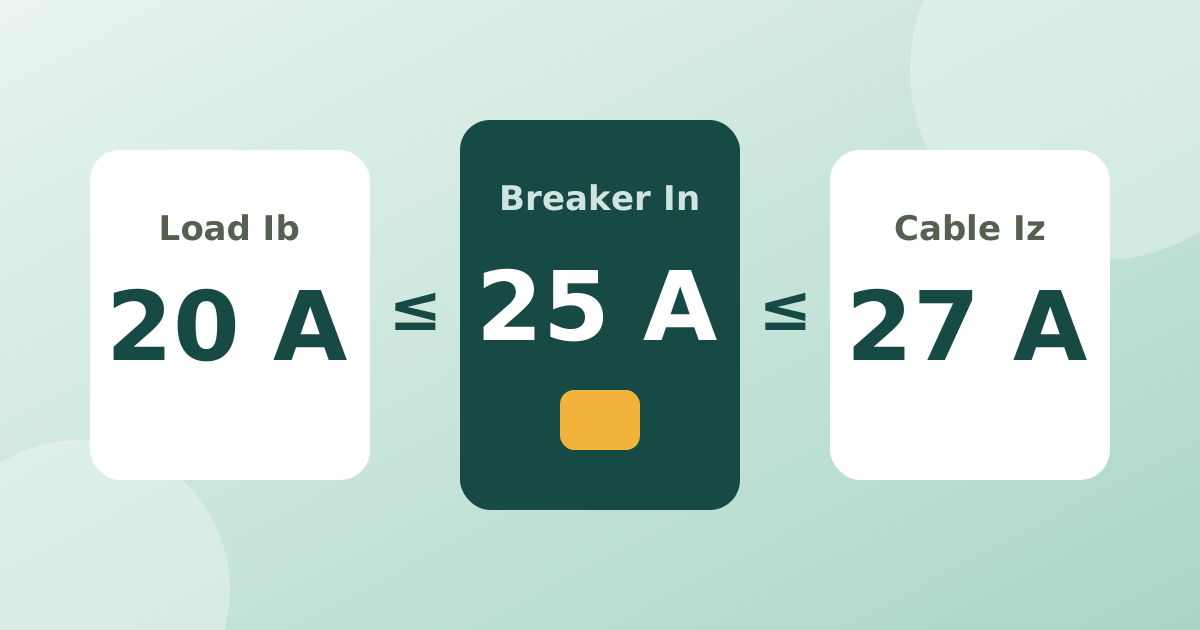
Breaker. The smallest standard rating at or above 32 A is 32 A. The rule is IB ≤ In ≤ Iz.
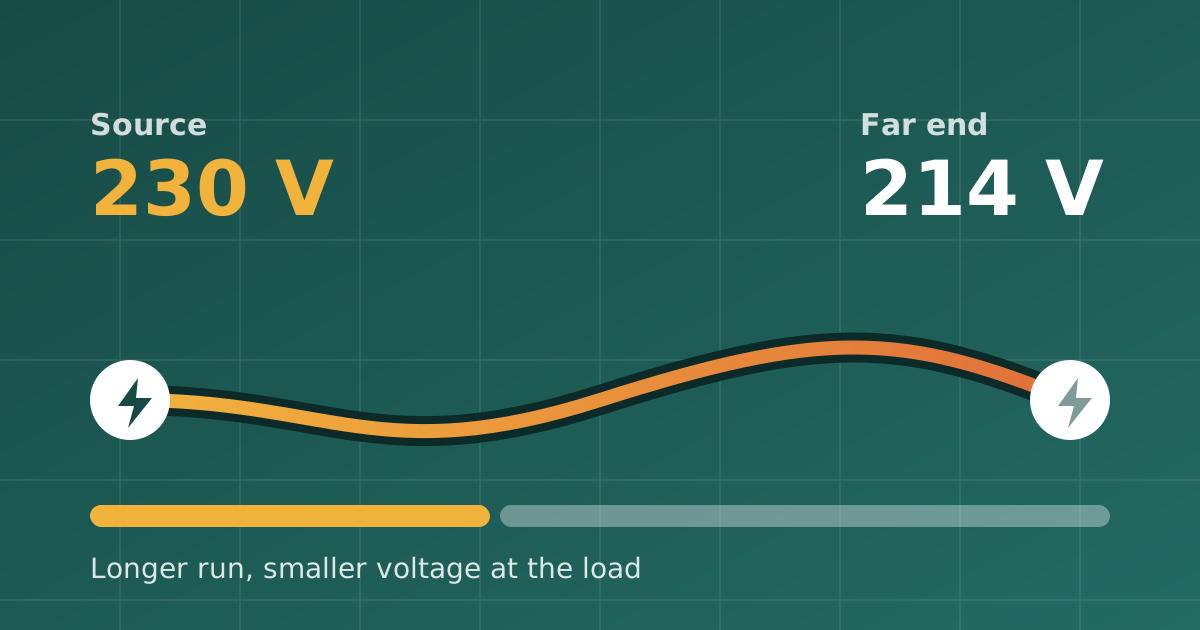
Voltage drop. Long garden or driveway runs are where cable size jumps. 32 A over 30 m needs 10 mm² because of the drop, not the current. The maths is in voltage drop: what to do when the cable is too long.
What else to check before installing
A dedicated circuit for each charging point.
RCD protection for each charging point, with DC fault detection: often a type A RCD plus 6 mA DC detection in the charger, or a type B RCD. The charger's manual says which.
Buried or outdoor runs. Direct-buried cable (method D) and cable in direct sun use other factors than the table above.
Your supply. The main fuse and the rest of the house load need headroom, and many chargers can limit their current to protect the main fuse.
Local rules. National wiring rules may be stricter, and the installer remains responsible for the design.
Work out your own run
Use the free EV charger cable size calculator, which starts with a 7.4 kW charger on a 20 m run, or the general cable size calculator and voltage drop calculator. Cable Calc on Android does the whole chain offline: derating, breaker, voltage drop and cable size, with every intermediate value shown so you can check the working and send a PDF report to the customer.
Frequently asked questions
What size cable do I need for a 7 kW EV charger?
A 7.4 kW single-phase charger draws 32 A. On a 15 m run clipped direct to a wall (method C) 4 mm² copper PVC cable is enough for a 3% voltage drop; in an insulated wall (method A1) use 6 mm². At 30 m both rise to 10 mm², and at 50 m to 16 mm².
What breaker does a 7.4 kW EV charger need?
A 32 A breaker, equal to the charger's rated current. The cable must carry at least 32 A after derating for temperature, grouping and installation method, so that Ib is not more than In and In is not more than Iz.
Is an EV charger a continuous load?
Yes. It draws its full rated current for hours, so IEC 60364-7-722 treats it as a continuous load. Size the circuit for the rated current with no diversity.
Do I need a separate circuit for an EV charger?
Yes, each charging point needs its own dedicated circuit and its own RCD protection. The charger or the RCD must also handle DC fault current, so check the installation manual for the type required.
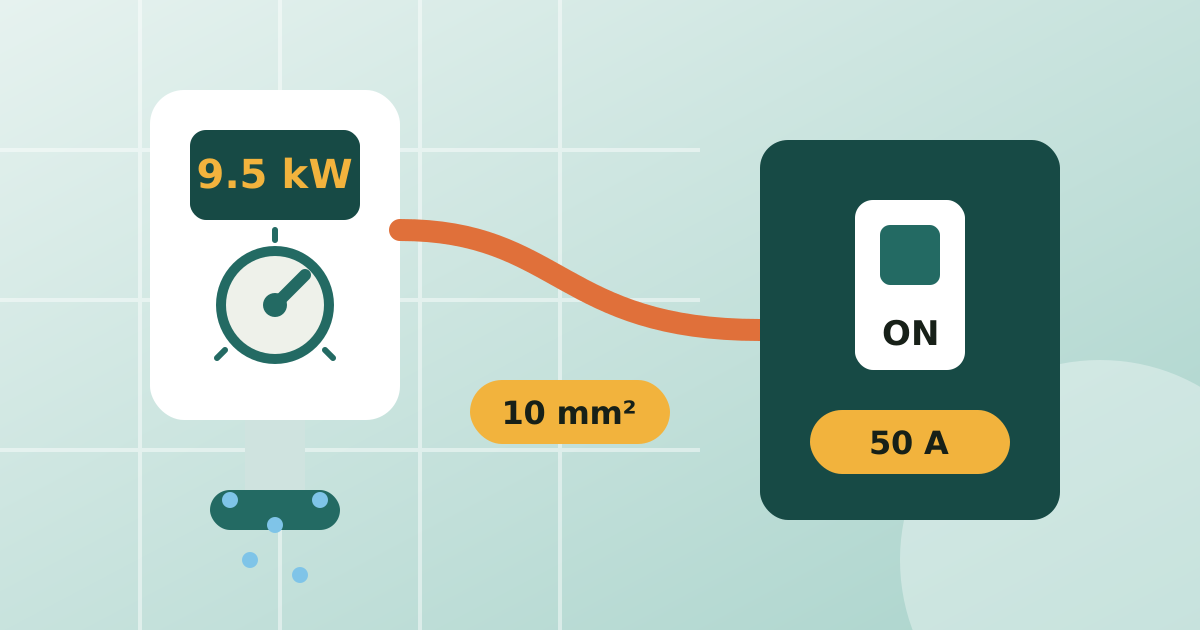
Electric showers are the biggest single-phase load in most homes. An 8.5 kW shower clipped to a wall needs 6 mm² copper; a 9.5 or 10.5 kW shower needs 10 mm², and 16 mm² in an insulated wall.