How long can you store hatching eggs before incubating?
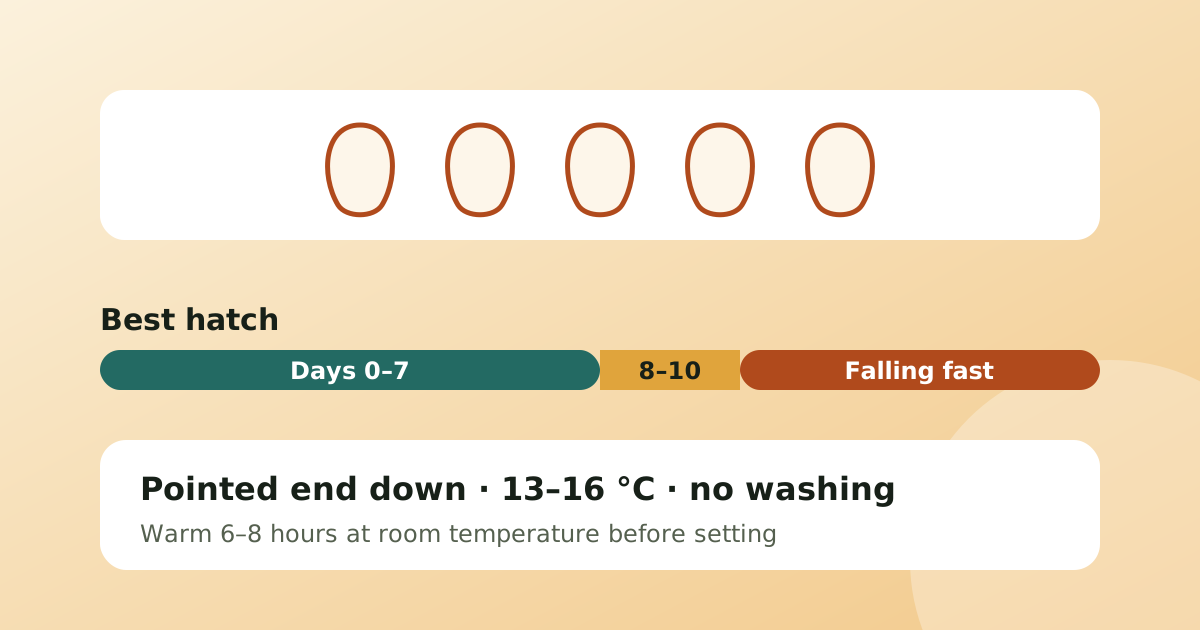
Set hatching eggs within 7 days of laying for the best hatch rate, and store them pointed end down at about 13 to 16 °C (55 to 60 °F) until then. Eggs can wait longer, up to about 10 days with little loss, but every extra day makes the hatch a bit weaker and a bit later. After two weeks the results are poor.
Why storage time matters
A fertile egg starts to develop only when it is warmed. Once laid and cooled, the embryo pauses, but it does not stay perfect forever. The white thins, the air cell grows as moisture escapes and the embryo slowly loses vigour. A stored egg therefore hatches later and less often than a fresh one, and weak chicks become more common.
Storage time at a glance
Days stored
What to expect
0 to 7
Best hatch rate, set whenever convenient
8 to 10
Small drop in hatch rate, hatch may run a few hours late
11 to 14
Clearly lower hatch rate, more weak chicks
Over 14
Poor results, only worth it for rare eggs
These are typical guidelines. Species and breeds differ, and small eggs such as Coturnix quail lose moisture faster, so many keepers set quail eggs within about 7 days. Fresh, clean, well-fertilised eggs always do best.
How to store hatching eggs
Collect often. Gather eggs at least once a day, and more in hot or freezing weather, so they never sit in a warm nest or freeze.
Choose well. Keep only normal-shaped eggs with strong, undamaged shells. Leave out cracked, very small, very large or misshapen ones.
Do not wash them. The natural coating on the shell keeps bacteria out. Dry-wipe a lightly soiled egg, and discard heavily soiled ones rather than scrubbing them.
Store pointed end down in an egg carton or tray, with the blunt end (the air cell) up.
Keep them cool, at about 13 to 16 °C (55 to 60 °F) and out of direct sun. A cellar or a cool utility room works. A fridge is too cold and too dry.
Tilt them if they wait. From about day 4 to 7, tilt the carton to the opposite side once or twice a day, for example by propping one end of the tray on a book.
Label the date laid in pencil on each egg or on the carton, so you can set the oldest first.
Warm the eggs before setting
Take the eggs out of storage 6 to 8 hours before you set them and leave them at room temperature. Going straight from a cool room into a 37.5 °C incubator can make condensation form on the shell, which can let bacteria in. Once warmed, load them with the pointed end down or on their sides, and start turning at least three times a day. See when to stop turning eggs for the end of the turning schedule.
Stored eggs hatch a little late
Do not be surprised if a batch of week-old eggs starts hatching a few hours after the due time. The hatch date calculator counts from the day you set the eggs, not the day they were laid, and the incubation chart lists the days for each species. If the eggs go in a few days after laying, count day 0 from the day they go into the incubator.
Plan the batch so storage never goes wrong
If you collect eggs for several days to fill a tray, the earliest eggs are the oldest by the time you set them. Record each laying date and set the batch once you have enough, ideally within the 7-day window. Hatch Day counts down to hatch day for 11 species and reminds you about turning, candling and lockdown, with daily temperature and humidity targets. It is free on Android and iPhone and works offline.
How long can you keep hatching eggs before incubating?
For the best hatch, set eggs within 7 days of laying. Up to 10 days is usually fine, but hatch rates fall noticeably after that and drop steeply after about two weeks.
What temperature should hatching eggs be stored at?
About 13 to 16 °C (55 to 60 °F) with moderate humidity, in a cool room away from sun and draughts. Do not put them in a fridge, which is too cold and too dry.
Should I turn eggs while storing them?
Store them pointed end down. If they will wait more than about 7 days, tilt the carton to the other side once or twice a day, which helps keep the yolk from sticking to the shell membrane.
Do I need to warm eggs before putting them in the incubator?
Yes. Let them sit at room temperature for 6 to 8 hours first so they do not sweat or shock when they meet the incubator heat.
Should I wash hatching eggs?
No. Washing removes the natural coating that keeps bacteria out. Set clean eggs, and gently dry-wipe a lightly soiled one.
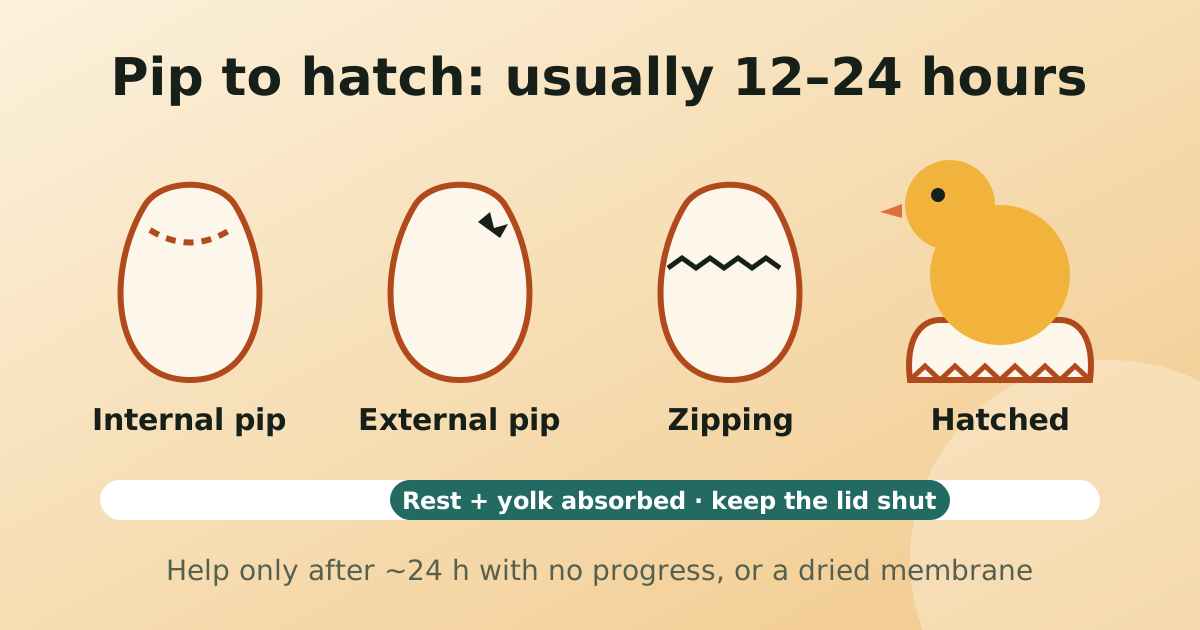
A pipped egg can sit for a day without any visible change, and that is usually normal. Here is what happens between pip and hatch, how long each stage takes and when helping is worth the risk.
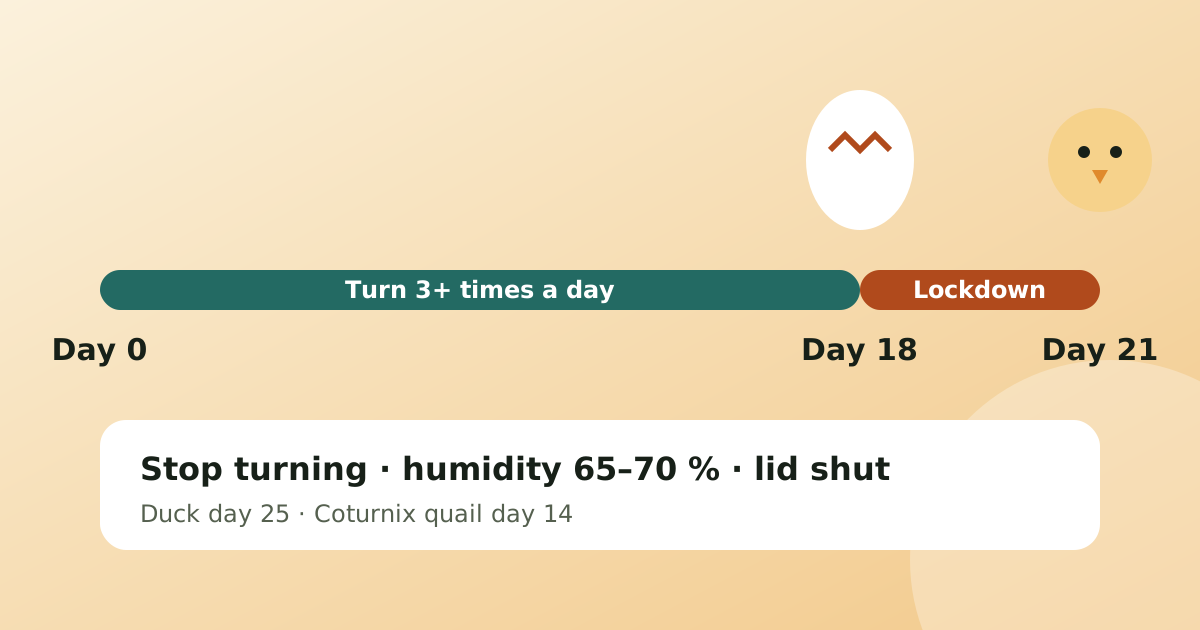
Stop turning eggs three days before they are due: day 18 for chickens, day 25 for ducks, day 14 for Coturnix quail. Raise the humidity, keep the lid shut and wait.
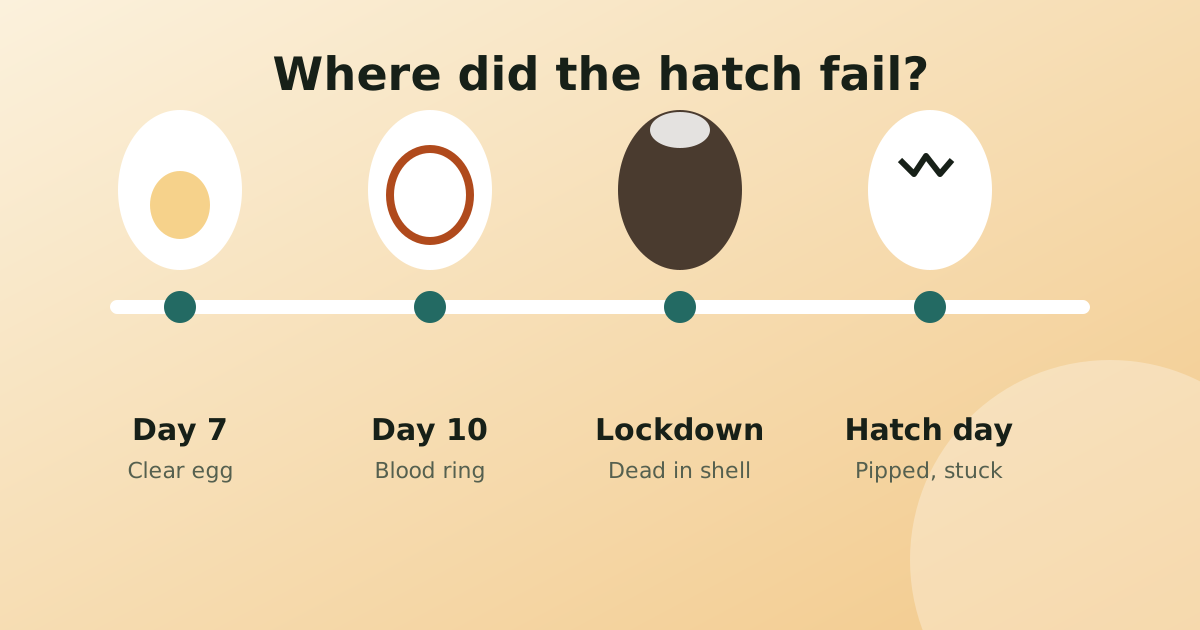
Work out why your eggs did not hatch by looking at when they failed: clear at day 7, dead at day 10, or fully formed but dead in the shell. Each stage points to different fixes.